

To earn money as an affiliate, you generally have three options:
- Create your own website, build it step by step, and attract visitors naturally through search engines and external sources.
- Use external platforms such as social media and content-sharing sites, and find effective ways to attract the audiences you want to market to.
- Buy traffic by investing in paid sources to drive potential customers to your affiliate campaign.
All three options work. Many affiliates choose the first option because most experts recommend it. But is it the right approach? There are alternatives that require less time commitment and deliver faster results — for example, paid advertising.
Earning money as an affiliate with a website?
There are many ways to earn money with a website. One of the most popular ways is affiliate marketing. With affiliate marketing, you advertise the products or services of other companies on your website. You receive a commission for every sale that is made via your promotional link.
It's a simple strategy that website owners have been using since the internet began to commercialize.
There are many affiliate marketing programs you can use to earn money from your website. However, the first step is creating a site with valuable, engaging content for your visitors — and this is the challenging part. Building a website that naturally attracts the right audience isn't the easiest route for affiliate earnings.
Usually, it takes me between 4 to 6 months to attract the right number of visitors before the website starts earning its first steady income. During this time, you're working voluntarily, hoping for the success of tomorrow.
Many people aren't comfortable with that. They want instant traffic and instant earnings. And that's understandable, especially if you treat affiliate marketing not as a hobby, but as a profession.
The big advantage of having your own website is that you can use it not only for affiliate products, but also later for your own products or services. Or you can even sell advertising space to advertisers to make money.
Another benefit is that you own your audience. People who visit your site regularly and become fans of your content are considered part of your audience. As long as they keep coming back, you have multiple options to monetize this audience.
In the best case, you get visitors to subscribe to your email service and build your list directly through the site. This is the absolute best way to not only fully own your audience, but also establish a lasting connection with them for years to come — unlocking long-term monetization opportunities.
The website can be ideally used to sell your own products or services as well. This can be anything from physical goods to digital products such as online courses or e-books. A website is the ideal platform for this.
ou see, owning a website — even as an affiliate marketer — is a solid strategy for building sustainable income that lasts for years. The price is high, though: you need to first build a website that attracts the right visitors. And that's the hardest part.
What are the pros and cons of using a website as an affiliate?
Let's take a look at the key benefits of owning a website:
- You have full control over how you earn money on the website. Nobody can tell you how to monetize it.
- Stable income through stable visitor numbers, provided you manage to generate stable visitors via social media and search engines through strong content.
- Website owners can generate revenue through advertising, selling products and subscriptions or through email marketing.
- Websites can serve as platforms for social networks and blogs, connecting people with like-minded people.
- Websites also serve as a digital portfolio, allowing entrepreneurs to showcase their work in an easily accessible format. But an affiliate can also demonstrate a high degree of professionalism.
Of course, like any business opportunity, there are some downsides to consider:
- Creating a website is not easy. You have to get to grips with the technology and invest time.
- You have a lot of responsibility, because you are the operator of the website and have to comply with legal regulations.
- Running a website takes a lot of time. In many cases, running a website professionally is a full-time job.
- Since you usually have sole control over the development of the website, gross errors can even ruin the website economically.
- And you have to bear in mind that you are committed to a website for a long time. It is not uncommon for websites to be operated for decades.
When we focus solely on the cons, it's clear that building a successful website is a challenging job. It's not for everyone. Many people will abandon their site within the first three months once they realize that a website is a long-term asset — it's not something that generates immediate profits as soon as you start building it.
Do you need a website to earn money as an affiliate?
Now, here's the real question: Do I even need a website to earn money as an affiliate?
And here, I can assure you, it's important to know that creating a website is not a must for affiliate marketing. Many affiliates simplify the process by leveraging external websites and platforms. Take YouTube, for example...
Countless affiliates build a YouTube channel with as many subscribers as possible instead of a website and use the platform to promote products. They simply use a third-party website to earn money.
You don't own the technology or the data, but you can tap into existing audiences on other platforms to earn money. This is faster than building a website and much easier, but it still requires creating content that attracts your desired audience.
The same can be done with other platforms, be it Facebook, Twitter, Instagram, TikTok or hundreds of others. All you have to do is create content that others like.
However...
Your website can serve as a crucial foundation for making money. When using other platforms, however, you risk having your account closed. For example, if you upload videos to YouTube and commit repeated copyright infringements, your account could be banned.
And then you're out — no audience, no income. All the work you put into building your visibility and reach on the platform is gone.
Nobody can easily take away your website.
If the technical operator of your website, also known as the hoster, terminates your contract, you take the domain and all website data to another provider and are back online within a few hours or days.
Traffic is back, and so are earnings.
Nowadays, you can add multiple traffic sources to your site to ensure a steady, reliable flow of visitors, even if one traffic source dries up.
When it comes to stable, sustainable traffic, I can only recommend:
Owning a website requires building multiple traffic sources simultaneously and never relying on just one, as it can be very fragile.
On the website you are in now, Affiliness, has multiple traffic sources:
- search engines,
- social media,
- paid ads,
- email makreting,
- affiliate ventures,
- and direct visits.
It's because it's not a traditional information-based website — it's a business, a serious one. I can't put all my eggs in one basket, like relying solely on search engines, which require ongoing SEO efforts that change regularly.
There's always the potential risk of losing visitors and customers entirely. By building your website on the foundation of multiple traffic sources, it becomes almost impossible to lose steady traffic and earnings.
However, you also have to keep in mind that it can take months and years for a website to generate stable income. Too many factors play a role in the amount and sustainability of income, especially the quality of the content and the regular creation of content should be emphasized here.
Social media and paid ads — a quick fix for the headache
What do most people do when dealing with a headache? They take a pill.
It gives them almost instant relief and immediate results.
Social media and paid ads also give you almost instant results when working as an affiliate. You don't have to wait months, like with your own website, to start getting stable visitors and earning money.
Just look at the instant user base available when you use a social media platform:
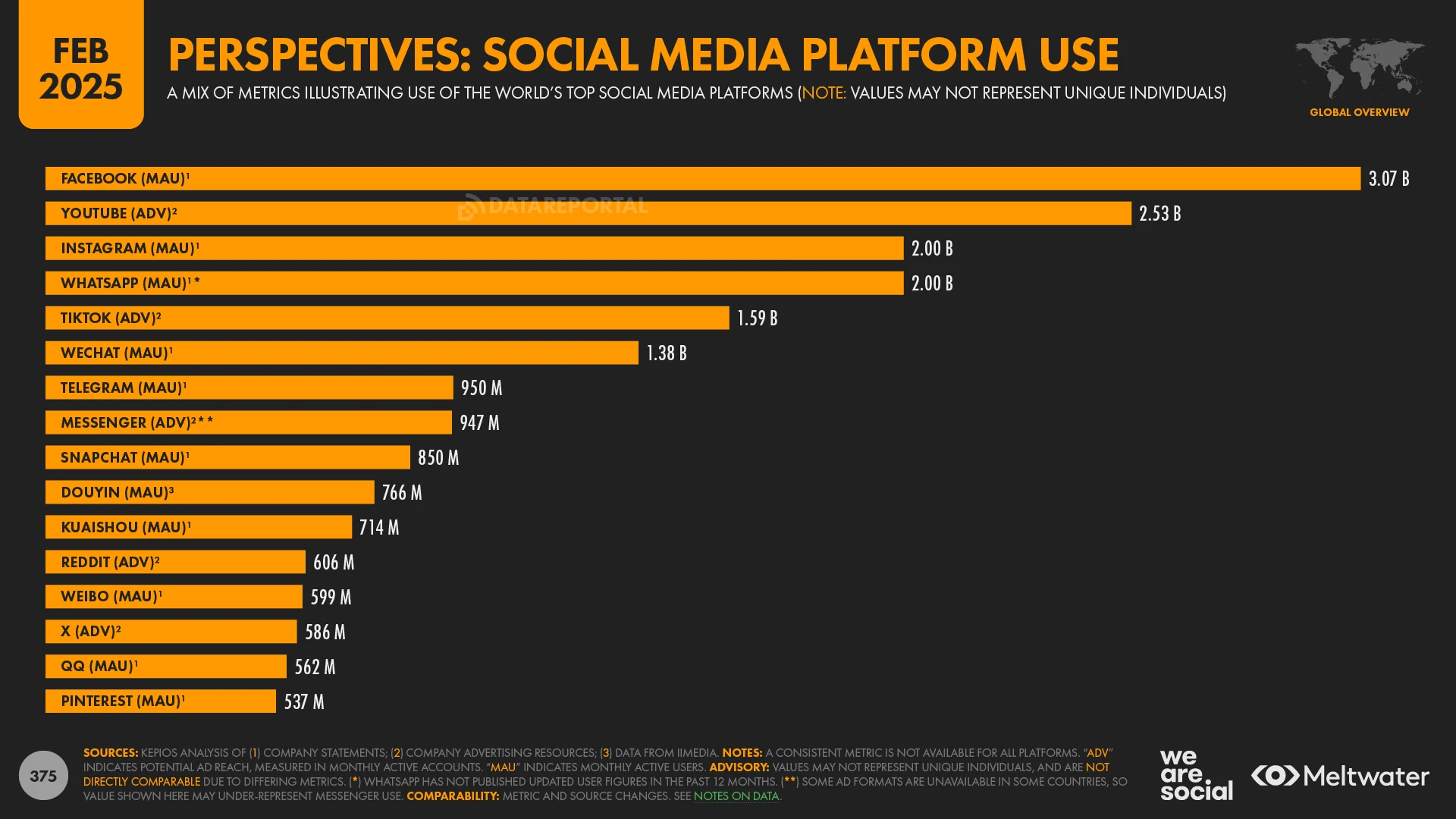
Try to reach these numbers with your own website — it's impossible. On social media, audiences with any interest you focus on are available instantly. This means you can reach them very quickly with your affiliate offers.
You choose a niche topic and focus entirely on it on the platform of your choice — for example, YouTube. You create content that resonates with people on that platform and build an audience, which is a much faster process than doing it through a website.
In some cases, you can use strategies to leverage existing spaces on the platform to earn money even faster — sometimes even on the same day you start. This involves finding creative ways to promote, such as writing valuable comments and recommending products as solutions to clear problems.
What I'm telling you is that, in most cases, external platforms are the faster way to start earning as an affiliate. The audiences are already there, and you only need to find a way to attract them.
It's a completely different story with your own website, where you need to build your audience from scratch, step by step.
Conclusion
It can be a good idea to use the website as an affiliate to earn money. It offers a certain stability if it is run professionally and, above all, actively.
However, setting up and running a website is no easy task. Many websites are abandoned within a few months because the operators have underestimated the effort involved.
In many cases, it can even be an advantage not to have your own website and simply use other platforms on the internet as an affiliate. This saves a lot of time, which can then be used to get to know the other platforms better and, above all, to learn how to use them profitably.