


Alongside many other ad platforms, Facebook Ads has quickly climbed to the top in recent years. Sure, Facebook isn't as attractive as Google Ads for affiliates, but you can still use its huge reach profitably.
Without doing much research, you'll quickly notice that Facebook is very picky about who gets to advertise. Signing up as an affiliate and trying to make money with mediocre campaigns will almost always end with a banned ad account.
You also need to remember that Facebook doesn't like sending users to external websites. Facebook does everything it can to keep people on the platform — like a farmer who wants his sheep to stay on his field.
So you can't expect Facebook to happily pour its valuable traffic into your cup.
Can you advertise as an affiliate with Facebook Ads?
Meta's advertising platform doesn't generally allow direct affiliate links as a destination URL in ads. Even if the affiliate link technically works, it's often flagged or disapproved because the platform wants higher-quality landing experiences and doesn't like redirects that it can't verify.
I've read through the Facebook Ads policies and also tried promoting affiliate products myself. There are no explicit rules against affiliates, but my ads still got rejected — probably because the product was an online business course.
If your ad gets rejected once, STOP what you're doing. It's a red flag. If you repeat this, they will disable the Ads account, so you won't be able to create or manage any ads, which is bad because a lot of genuine opportunities will disappear right in front of you!
Taking a closer look at the policies explains why they don't like certain offers:
Ads must not promote financial products and services that are often associated with misleading or deceptive promotional practices.
This basically means you can't promote products from the internet marketing niche, since many of them are advertised aggressively and often make unrealistic promises.
So, all the people promoting weight loss pills are surely no longer customers of Facebook Ads, either.
Another important rule:
Ads must not promote products, services, schemes, or offers that use deceptive or misleading business practices. This includes ads that attempt to scam users or trick them into giving personal information.
If you promote products that use shady or misleading tactics — which is sadly common in many industries — Facebook won't allow it.
So if you want to advertise affiliate products on Facebook, you need to be very careful about what offers you choose. There's a good chance Facebook won't like your offer, especially things like online weight‑loss courses.
Which Facebook Ads strategy is safe and allowed?
It shouldn't surprise you that the best advertising on Facebook is the kind where users stay on Facebook. As mentioned earlier, Facebook doesn't like sending people away. They want to keep the users on their platform.
The safest and most effective Facebook Ads strategy is promoting your own content that lives directly on Facebook.
Here's how you do it:
- Create a Facebook page for a topic, product, or brand.
- Post useful and informative content regularly.
- Occasionally publish posts with promotional intent and include your affiliate link.
- Start a Facebook ad campaign and promote your single posts or your entire page.
By keeping users on Facebook, your ads are far more likely to run long‑term — as long as the products you promote follow Facebook's rules.
The example below, High Brew Coffee, shows a Facebook page dedicated to coffee. It posts content and includes promotions that lead users to external sites.
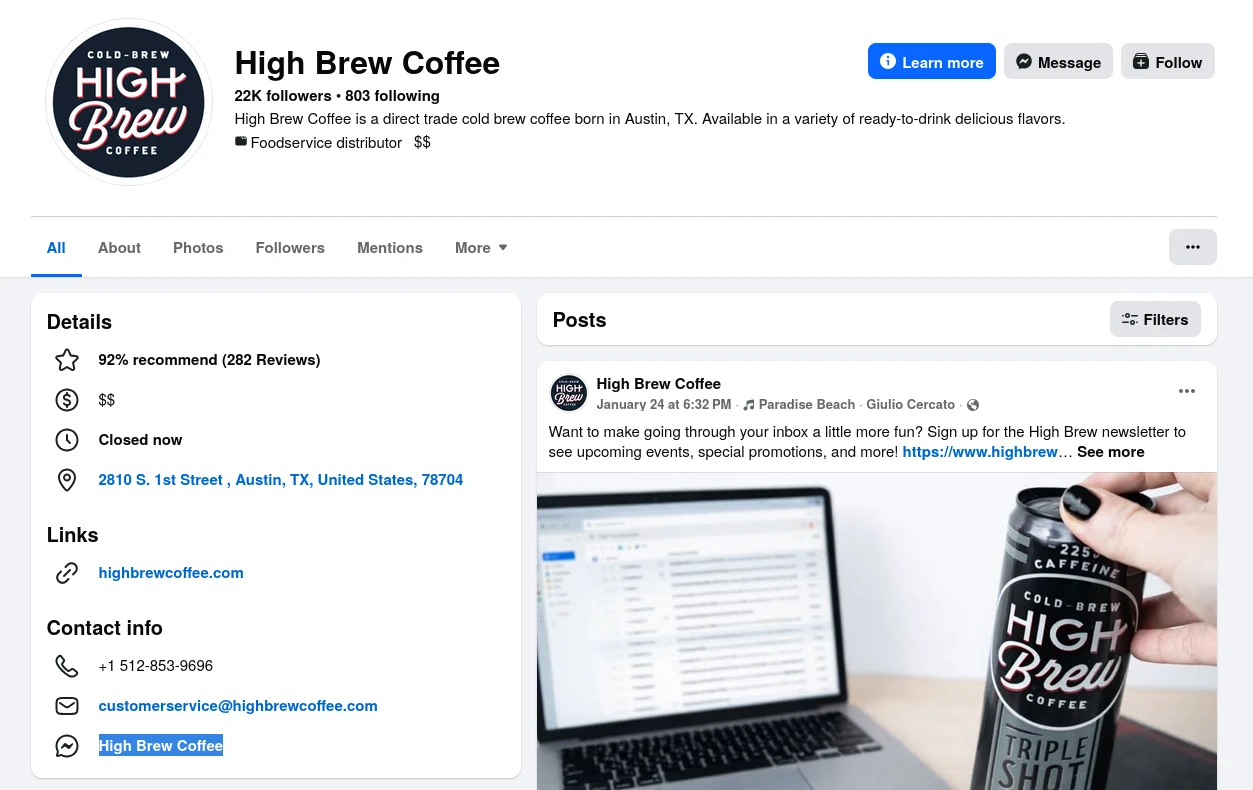
That's a smart approach to using Facebook to earn money as an affiliate. It doesn't take long to build a page like this, either.
Your page needs a clear theme and a target audience you can reach with Facebook Ads. Used sparingly, you can even include affiliate links directly in posts — as long as you don't overdo it.
Facebook will definitely not have a problem when you promote coffee machines because, as we all know, almost all employees in tech companies are coffee addicts.
Facebook Ads for external websites
Because Facebook has such a massive reach, many affiliates try to use it to quickly drive traffic outside of Facebook. While this method can work for trusted, authoritative companies, it definitely won't work for small advertisers. As we know:
Facebook wants full control over where its users end up when they click on an ad. I fully understand why.
If you want to direct traffic to an external page through ads, use a different platform. We need to play by the rules of the platforms we use for marketing. That's the reality.
To succeed with Facebook Ads, you need to understand how the platform works and what it favors when it comes to ads. Ads that keep users on the platform are usually more effective than trying to direct traffic to external sites. Read this BlackHatWorld thread for proof on that.
Industry reports and recent analyses show a shift in Meta's delivery systems where:
- Ads linking to external sites or unknown domains tend to get reduced reach.
- Formats that keep users on Meta platforms — like Instant Experience ads and Lead Ads (on‑platform forms) — are being prioritized as they drive higher engagement within Facebook/Instagram.
So why does it happen?
The algorithm is optimized for engagement and time spent in the app, which increases ad revenue and user retention. These benefits are completely bypassed if you try to direct users outside of Facebook or its app.
Conclusion
For affiliates, it's getting harder and harder to find buyers through paid ads. Many affiliates have created high entry barriers by trying to make fast money with minimal effort.
Facebook Ads is honestly one of the worst platforms for beginners. The standards are high, the rules are strict, and getting even a single click can be expensive.
Promoting products online without a website is becoming more difficult. To succeed with Facebook Ads, you absolutely need to follow three rules:
- Connect your ads to content that lives on Facebook.
- Use a high‑quality, helpful landing page when sending traffic off Facebook.
- Never link directly to third‑party products with your affiliate link — never show Facebook that you're an affiliate.
If you follow these rules, you'll already be ahead of most marketers and affiliates trying their luck with Facebook Ads.