

I've seen pretty much every crazy idea affiliates come up with to promote products. Some ideas are super creative and refreshing, others...
An affiliate once ran Google Ads bidding on "customer support phone number + brand name", sending desperate users to a fake "support" landing page. The page calmly told them the problem was common, and the solution was buying a paid software tool — which, surprise, was their affiliate offer. It converted insanely well for a few weeks... until the brand caught it and the affiliate (and account) got nuked.
Don't do this. It can lead not only to a suspended advertising and affiliate account, but also to legal issues.
If you want to make money as an affiliate, you need creativity and a sense of legitimate ways to earn money, not dirty shortcuts.
One very popular shortcut strategy is promoting affiliate products through Google Ads. Especially, beginners think they've found the holy grail for traffic and fast commissions — which is a big mistake.
Is Google Ads affiliate‑friendly?
Google doesn't explicitly ban affiliate marketing, but directly linking an ad to an affiliate tracking URL (e.g., a ClickBank hoplink or similar) is very frequently disallowed under its Destination requirements and quality standards. Ads often get disapproved or accounts penalized when the destination is an affiliate link or a redirect/bridge that serves no real content.
A quick workaround is:
Send traffic to your own landing page or website that provides useful content (reviews, comparisons, etc.) and then includes your affiliate link. That gives users value before they click through. That's perfectly allowed with Google Ads, as long as the content is valuable and doesn't promote illegal offers.
Affiliate ads are often rejected, and sometimes entire accounts are banned. All ads are reviewed manually, even if an ad campaign is already running. Don't think you can trick them. There will be a heavy price to pay.
So let's be clear: being an affiliate and running ads on Google Ads is a risk.
To be fair, affiliates often make pretty dumb mistakes or try to push the limits in shady ways, which gets them banned.
Google doesn’t necessarily have a problem with affiliates — they have a problem with affiliates who do things wrong or try to cheat the system.
So what’s the real issue?
The real problem with Google affiliate ads
The problem isn't that you're an affiliate — it's that many affiliates create ads that don't help the person searching. Let's look at an example: ads for the keyword "switch life insurance" which you can see after a search with Ecosia.org:
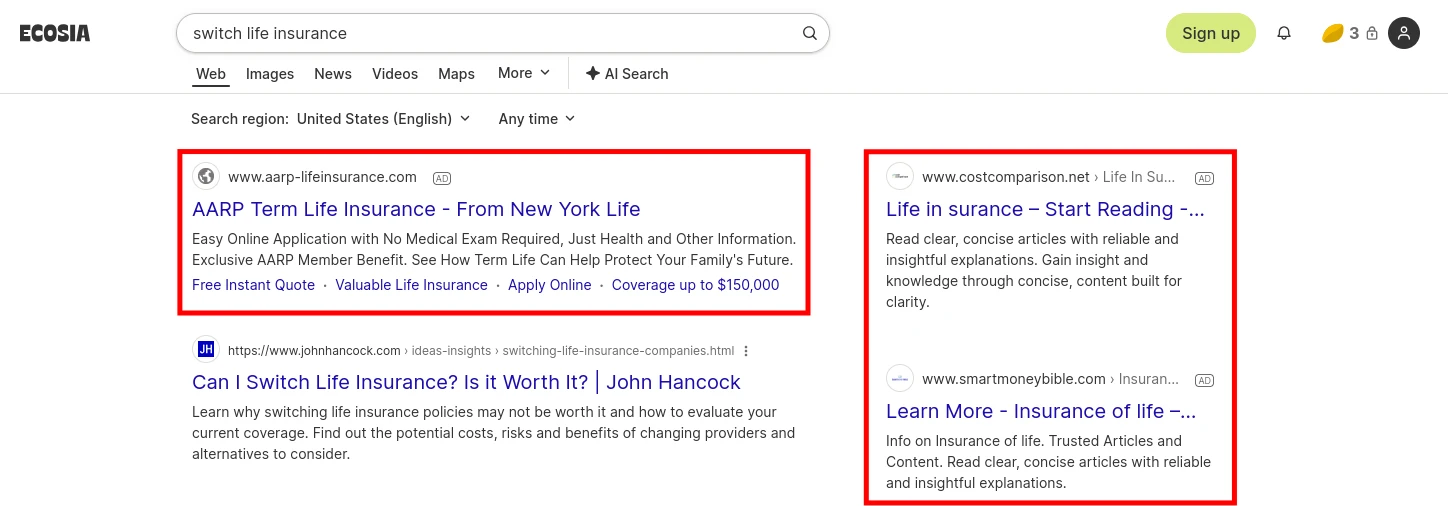
All the ads in the screenshot show the problem perfectly.
The searcher is most likely looking for information on how to switch any insurance. But the ads try to sell a specific insurance instead.
These ads are basically irrelevant and don't help the searcher find what they want.
Sure, the advertisers probably had their reasons, but I'm almost certain these ads are not effective.
This is the same mistake most affiliates make!
They create ads that simply aren't relevant. Google sees that, rejects the ads, or bans the accounts because it's obvious the affiliates aren't good advertisers.
The right way to advertise as an affiliate with Google Ads
Now we know what not to do. What to do instead?
You optimize your ads for what the searcher actually wants.
Let's say you want to promote an email marketing software. How would you use Google Ads correctly?
You go to Google, type in the keyword you want to target, and look at what the search results show. You need to understand the search intent.
- If the results are mostly shops selling the product, you should create a landing page reviewing one or more related products.
- If the results are purely informational, create an informational article and only promote the product after providing proper advice on product selection.
It's simple — but you need to understand what your ad is supposed to achieve.
You'll get huge benefits if you align your ads with what people actually want:
- Relevant ads
People who click are genuinely interested in what you're offering. - More efficient ads
You avoid paying for clicks from people who won't buy anyway. - Real value
You're actually helping people find what they want. - Google approval
If Google sees you're helping users, your ads are more likely to be approved.
Promoting affiliate links directly or not?
The big question: can you promote an affiliate link directly with Google Ads?
The safest answer: Don't promote directly, use landing pages instead.
A landing page can be informational or promotional. You set it as the final URL in your ad, and everyone who clicks lands there.
This shows Google:
- You put in the effort to create a page that respects the user's intent and improves the user experience.
- You actually care about user intent and want to help them find what they want.
- You understand why landing pages matter.
- You know what you’re doing.
As an affiliate, you want to look professional. Not like an amateur. Amateurs are kicked off everywhere; it's not just Google, Facebook, and the other big players. No one wants amateur affiliates spamming affiliate links and promoting pills that make empty promises.
Understanding the basics is crucial for paid ads. One of those basics is using landing pages optimized for ads. Many affiliates neglect this step and then complain when Google rejects their ads or disables their account.
I've learned one very important lesson over the years:
If you're willing to go the extra mile, you'll earn more, and it will mostly be a sustainable affiliate income.
Go the extra mile.
Conclusion
Google Ads is one of the biggest ad platforms in the world. It's absolutely worth learning how to use it properly as an affiliate.
I've shown you what doesn't work — and what does. One thing is certain: you can't just put your affiliate link into an ad, add a few random keywords, and expect success.
This strategy used to work at the beginning of the internet, when affiliates made millions. Today, however, that's no longer the case. You need to find a strategy that actually gets you results.