

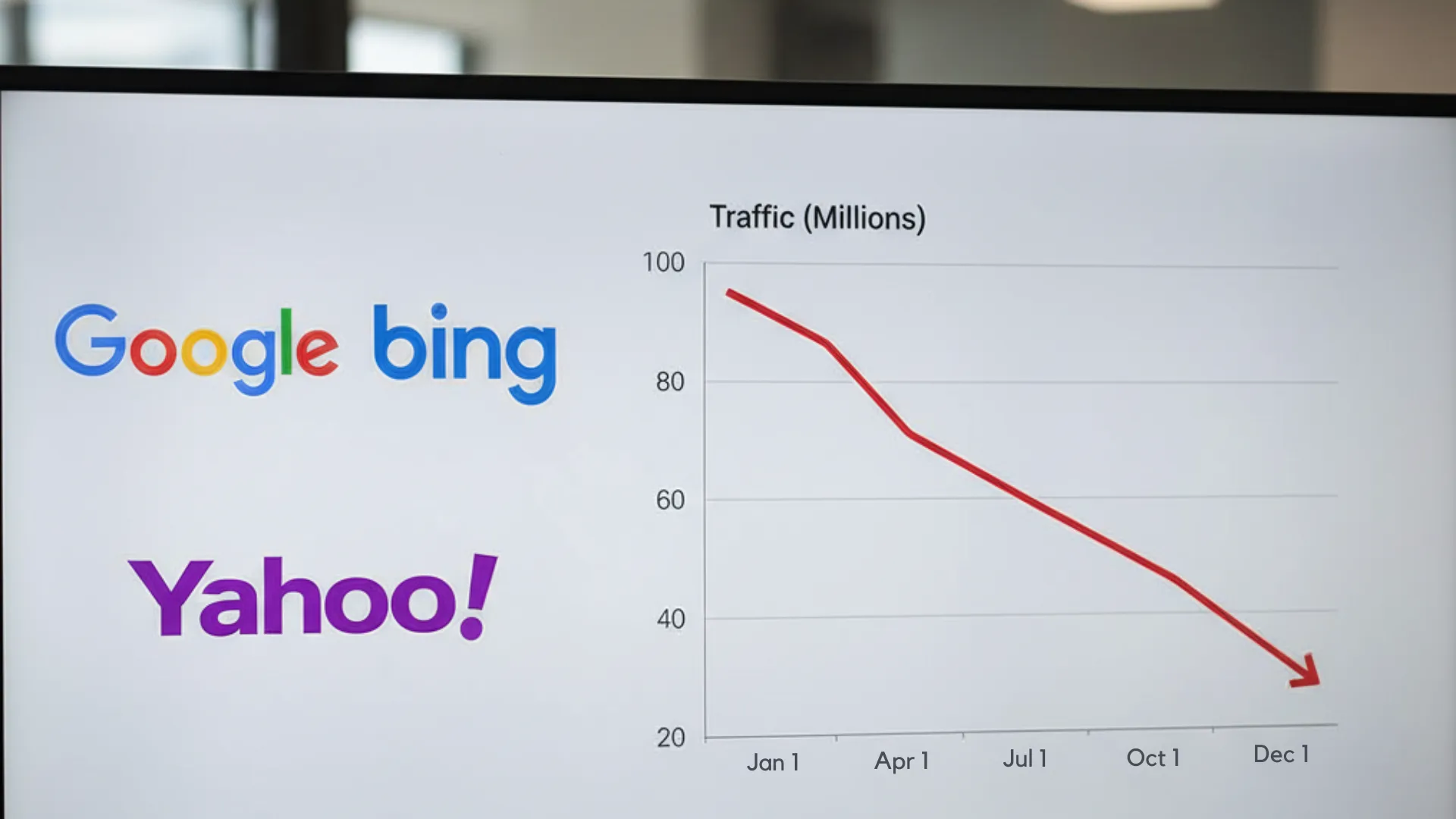
To briefly describe the current state of SEO: it is evolving as user behavior shifts from traditional search engine queries to social media and AI-driven tools.
Internet users are increasingly skipping Google searches and conducting their research on platforms of their choice, such as YouTube, TikTok, Pinterest, and many others. AI has amplified this shift, as more users now turn to chatbots to get instant answers, making traditional search engines less relevant.
However, don't panic — SEO is still alive and continues to breathe. As affiliates, we can leverage it to build niche sites we're passionate about, which can generate income from search engine traffic.
One question right at the beginning:
Why have the search engines jumped on the AI bandwagon so quickly?
- Is it because AI is "smarter" than a human author?
- Or because it's trendy and as an innovative company you have to follow the trend?
- Or maybe because AI has so much potential that you can't afford not to use it to make more sales?
All wrong.
And a little fact on the side: Google has been using AI for DECADES to improve the quality of its search results. So AI, especially in the search engine market, is certainly not fresh made coffee.
The real reason for the increasing use of AI in search engines is:
Search engines have realized that user search behavior has changed. Users want answers IMMEDIATELY and no longer want to click through lots of websites.
More and more search engine users no longer want to visit websites and search for information themselves, they want the right answer immediately, directly on the search results page. Manual website research should only be optional.
You probably know this yourself...
How often have you ended up on a web page that's several thousand words long after a search, even though the actual content you're interested in is only a few paragraphs, sometimes even just a few sentences.
It is an imposition to consume such content, if only because of the time factor.
The evolution of SEO standards has led to the current challenges: more and more bloggers and website owners have raised content standards to the point where content often becomes purely a marketing tool, rather than something users are genuinely interested in or enjoy consuming.
In this way, SEO has almost undermined itself by prioritizing optimization over true user value.
Search engines have noticed this serious issue and needed to slow down the SEO "madness" that built up over years of misuse. The result?
The priority of search engines is shifting more and more to the immediate gratification of the user and less to the free provision of available web resources in the form of web content.
Those who can provide answers quickly will win; everyone else risks being left behind. Instant answers are now the game, while long-form articles are becoming a niche for readers willing to sift through large amounts of text — often over 50% filler added by SEO "experts".
I am not writing this text because I want to be at the top of the search engines for certain terms, but because this text is helpful for my current and future readers.
I wouldn't invest another minute in creating content solely to rank on Google or other search engines, as they are rapidly losing ground. It should be clear that a multi-channel approach is the future. Anyone who relies on search engines as their main source of traffic risks jeopardizing their business.
Is today's SEO a gamble for the naive?
I am constantly creating new websites and I am always amazed at how long it takes for search engines to take the content of a new website "seriously".
Nowadays, it often takes like 3–6 months for a new website to get its first stable visitors from search engines. This means that you have to work on your website for months before you can see if you are rewarded for your work.
And a side note to all the ADHD brains out there: building a website can be a rough ride, as you won't see instant results. This can affect both your motivation and dopamine levels, making it harder to stay consistent and engaged.
The solution? Adopt a multi-channel approach.
Create content with the goal of generating free, organic traffic from search engines, while simultaneously building your audience on external platforms like Facebook, YouTube, and others. Direct this audience to your site to boost your traffic numbers — and gain the motivation to keep going.
By the way, this approach is fundamental to the Affiliness Success Program, which is available to all Affiliness members.
If you're unlucky, after 6–12 months you may discover that no one visits your website and search engines essentially ignore it.
Anyone who relies solely on SEO for marketing and earning money will face sleepless nights if they focus only on it. Why? Because SEO is in decline — this is a fact. Traffic is being directly and noticeably affected; just ask any major website in any industry.
However, in business, only results matter — results in the form of inquiries from prospective customers and actual sales.
Now you stand there as an SEO marketer, create great content for many months and after more than a year you have to realize that you don't even have a hundred visitors per day on your website, although you have already published numerous valuable content/subpages on your website. Ouch.
The problem?
Every single piece of content on the website has to start from scratch and build a reputation with the search engines before it can get visitors/readers.
And this reputation-building process can take months — or even years! I've seen this firsthand, not only with Affiliness but with numerous niche sites. All of them faced a long road before achieving their first visible Google rankings.
In today's business world, however, we don't have that time. In that time, you're already making good money with your business or you're already broke.
Should we still create blogs and content?
Given the decline in SEO, it's reasonable to question the necessity of creating content. The answer here is clear.
Yes, you need to create content, because really you should be doing it for your users and customers, not for the search engines. Search engines should no longer be seen as the main reason for creating content.
However...
Anyone who thinks starting a blog today to get free traffic from Google and other search engines is a brilliant idea will, in most cases, struggle to achieve impressive results — especially if they aren't planning to truly dominate their niche or leverage other channels besides search engines to drive traffic to the site.
I'll just mention three terms:
- Sandbox, where all fresh websites and content end up and can play there for a very long time.
- AI, because thanks to AI, anyone can now create tons of content on any topic filling Google searches with low quality content.
- Competition, because everyone wants to be at the top and unfortunately there are only 10 search results on the first search results page.
Create content and attract readers from multiple sources — social media, paid advertising, and more — as many successful marketers, including myself, are doing. Delight your audience, and you'll gain loyal readers and customers.
But the SEO experts say SEO is perfectly fine...
...and I say that the earth is a square.
Sorry, the SEO experts are lying — all of them.
SEO experts earn their money with SEO. Of course they're not going to saw off their own branch on which they've built a golden nest for decades.
The SEO industry is a BILLION-dollar market.
Even search engines are getting so desperate that they're offering tips on how to rank better — essentially trying to motivate new "volunteers" to jump into the SEO game and diligently create content for them. This way, they continue earning from search queries while gradually transitioning toward AI, which is slowly making traditional websites less relevant.
Some even go so far as to openly recommend "enhancing" your content — adding another 1,000+ words, for example — and taking measures like link building, all in an attempt to achieve better rankings despite the growing irrelevance of traditional SEO.
Why do they do this?
Because they make their money from the poor SEO faithful.
The SEO practitioners create content for them, and the search engines use that content not only to feed their AI engines, but also to directly display ads in the search results that match that content.
Anyone relying on SEO today should slowly wake up — SEO marketing is losing ground.
In this situation, in the long run, you're unlikely to come out a winner — more likely, you'll just waste your time and a lot of money.
In the worst case scenario, this can lead to losing your business.
What can we marketers do without search engines?
First, search engines are still performing well for now, even if they are losing user interest. So creating content that naturally attracts search engine visitors to your site is still definitely valuable.
Second, search engines are not the only way to drive traffic to your site. SEO has been hyped for decades as if it were the only option for attracting visitors — which is a lie.
There are many ways to survive with your online business without relying on search engines, most of which require other platforms, i.e. websites.
For example, I like to combine paid click advertising and email marketing to get stable traffic and revenue. These are very simple systems that make me money.
- You look for a platform that has the largest possible user base, be it Facebook, Tiktok, Instagram or whatever they are all called.
- You check whether there are ways to redirect users from the platform to your own website, whereby your platform is a website, even a simple landing page is sufficient.
- You create a marketing plan in which you define who your target group is and what content you can use to reach them, in order to finally lead them to your own platform with a clear call to action.
- You make sure that you either convert the users on your platform into money immediately or warm them up through a process of any length to make them more receptive to an order.
- You optimize the small system that consists of the above steps until it runs optimally and efficiently and ultimately helps you generate stable revenue.
It is worth noting that on many platforms you can find tools to use the platform directly to build a professional system. On YouTube, for example, you can build a community of followers and achieve very stable viewer numbers and revenue.
On Facebook, groups can be created that can also generate recurring revenue.
You only need to build up your own presence on the respective platform once and can benefit from this work for a very long time. Nevertheless, I would recommend using your own platform at the right time, preferably a blog or email system.
Conclusion
Anyone relying on content marketing today no longer needs to treat search engines as the cornerstone of their strategy. Search engines can still bring in traffic, but for how long?
Those who focus on content marketing today can largely bypass search engines and still achieve results and sales more quickly.
Do you need a search engine to:
- reach an audience of millions on Yoututbe?
- build a large following on Facebook?
- get millions of views for your visual creations and countless clicks on links on Pinterest?
No.
There are now so many platforms, each with hundreds of millions of users, that you can not only choose them over search engines for marketing purposes, but also get faster and better results.
We content creators and marketers — who helped make search engines successful in the first place — need to refine our strategies and incorporate multiple traffic channels into our marketing campaigns. That way, even if SEO traffic disappears completely, we'll still have visitors coming from other, more reliable sources.
We need to evolve and offer our content to those who truly value it and are willing to help creative people reach just the right audience.
As of the current state, I hope you get well soon, SEO, but please save us all from another wave of content creation standards that require articles 3,000–5,000 words long with less than 10% content and 90% hot air.